Glitch Pop and the Beautiful Mess: How Hyperpop Rewired What Music Is Supposed to Sound Like
Photo: myself, Public domain, via Wikimedia Commons
There's a moment in 100 gecs' "money machine" where the production just breaks. The vocal pitch-shifts into something barely human, the beat collapses into itself, and then — somehow — it all snaps back together like nothing happened. If you heard that in a pop song from 2005, you'd assume a file got corrupted on the way to the mixing board. In 2024, it's a signature move. It's intentional. And millions of people love it exactly because of that.
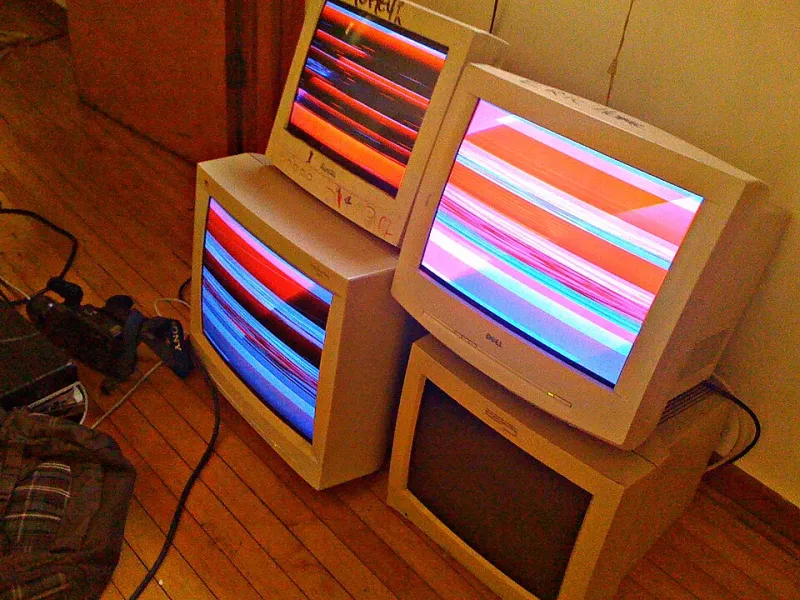
Hyperpop is what happens when a generation raised on YouTube compression artifacts, Discord notification sounds, and the general sonic texture of the internet decides to make music that reflects all of that honestly. It's not polished. It's not supposed to be. And that refusal to sand down the edges is arguably the most radical thing happening in American pop music right now.
Where the Signal Breaks
To understand why hyperpop landed the way it did, you have to understand what it was reacting against. The 2010s were dominated by a very specific aesthetic of sonic cleanliness — pristine production, meticulous vocal tuning, everything sitting perfectly in its frequency range. Streaming platforms rewarded it. Playlist algorithms loved it. Songs were engineered to feel frictionless, to slide into the background of a workout or a commute without catching on anything.
Hyperpop caught on everything.
The genre — if you can even cage it in that word — emerged from the UK's PC Music label in the early 2010s before mutating into something wilder once it crossed the Atlantic. Artists like A.G. Cook and SOPHIE were already treating the studio as a laboratory for wrongness, building tracks that sounded like bubblegum pop filtered through industrial machinery. But it was the SoundCloud generation, the kids making music in their bedrooms on cracked software, who really weaponized the aesthetic.
When Laura Les and Dylan Brady of 100 gecs dropped their debut album 1000 gecs in 2019, it felt like someone had fed every pop subgenre into a blender and hit pulse. Ska breakdowns next to screamo drops next to AutoTune so aggressive it circled back around to sounding emotional. Critics didn't know what to do with it. Fans immediately understood.
Mistakes as Features
The technical vocabulary of hyperpop reads like a list of things a traditional producer would fix before a track went to mastering. Clipping. Excessive compression. Pitch correction cranked past the point of plausibility. Jarring tempo shifts. Samples that don't quite sit right in the mix. In a conventional context, these are problems. In hyperpop, they're the texture.
This reframing of error as expression isn't new — noise rock, industrial, and lo-fi hip-hop all walked similar paths — but hyperpop's particular flavor is distinctly digital. The "mistakes" here aren't the warm crackle of a tape recording or the fuzz of a cheap guitar amp. They're the sounds of software straining, of files being processed past their limits, of the internet itself leaking into the audio.
For a generation that grew up watching buffering wheels and hearing audio artifacts on early YouTube videos, there's something deeply familiar about that. Something that sounds more real than a vocal recorded in a $10,000 isolation booth.
artists like Charli XCX — who has orbited the hyperpop world for years and whose BRAT era leaned hard into that aesthetic — have talked openly about wanting their music to feel lived-in, imperfect, human. Paradoxically, the most human-sounding pop music right now is the stuff that sounds most like a machine having a meltdown.
The Emotional Logic of Sonic Chaos
Here's the thing that critics who write hyperpop off as ironic noise tend to miss: it's actually incredibly emotionally direct.
The jarring transitions aren't random — they mirror the way anxiety actually feels, the way a thought can pivot without warning, the way grief or joy or dissociation doesn't move in smooth crescendos. A song that builds to a conventional chorus is telling you something is coming and giving you time to prepare. A hyperpop track that drops into a completely different sonic universe at the 45-second mark is doing something more honest about how emotional experience actually works.
Listen to anything from Dorian Electra's catalog and you'll feel this. The maximalism isn't decorative. It's structural. The chaos is load-bearing.
There's also something to be said about authenticity in an era when everything can be polished into meaninglessness. When AI tools can generate professional-sounding music in minutes, when every bedroom producer has access to the same VST plugins that major labels use, the deliberate choice to sound wrong becomes a statement. It says: a person made this. A messy, complicated, digitally-saturated person.
The Underground That Went Mainstream (Sort Of)
Hyperpop has had an interesting relationship with mainstream success. It never really broke into Top 40 radio — the format is too hostile to that kind of friction — but it colonized the internet in ways that radio can't measure. TikTok, in particular, became a hyperpop delivery system, with the genre's compressed, attention-grabbing sound perfectly suited to short-form video.
And then there's the way hyperpop aesthetics have quietly infiltrated mainstream pop without the genre itself going mainstream. The pitch-shifted vocals on a Doja Cat track, the blown-out production choices on newer Billie Eilish material, the way Olivia Rodrigo's "good 4 u" lets the distortion get genuinely ugly in the bridge — these are artists absorbing the lesson that imperfection hits harder, without necessarily signing onto the full hyperpop project.
The underground influenced the surface. That's usually how it works.
Why It Matters That It Sounds Like This
Voidcast exists in the space where the signal breaks and something stranger and more interesting takes over. Hyperpop is maybe the clearest sonic expression of that philosophy in contemporary music.
It's music that admits it was made in a digital world, that the tools left marks, that the process was messy and weird and sometimes uncomfortable. It doesn't pretend to be timeless. It sounds exactly like right now — which is to say, it sounds a little bit broken, a little bit too loud, and more emotionally true than anything that came out of a studio designed to eliminate all of that.
The kids screaming along to 100 gecs aren't celebrating failure. They're celebrating honesty. And in a media landscape built to optimize everything into palatability, that's a genuinely radical act.