Beautiful Failures: Why Gen Z Artists Are Treating Digital Glitches Like Sacred Text
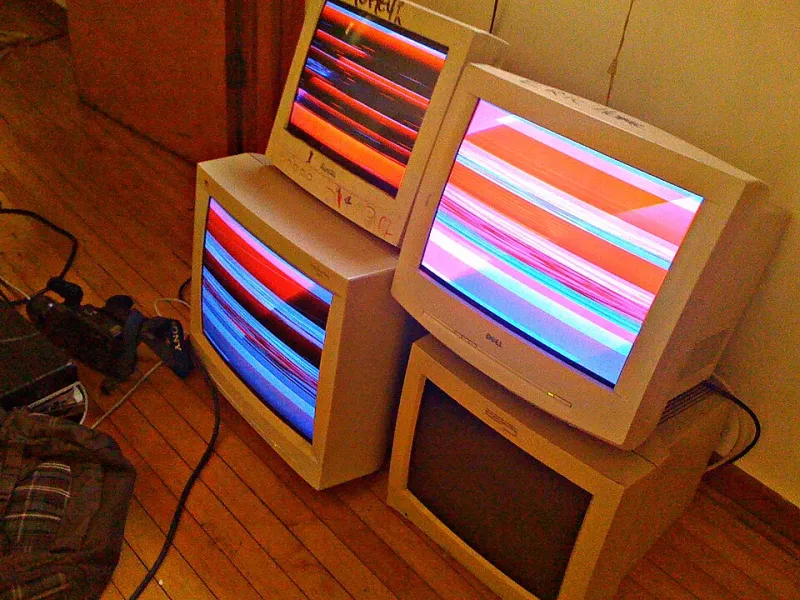
Photo: jonCates, CC BY-SA 4.0, via Wikimedia Commons
There's a specific kind of visual noise that lives somewhere between a broken TV signal and a fever dream — the kind you used to curse at when your DVD skipped, or when a file refused to open right. Today, that same noise is showing up in high-fashion editorials, major music videos, and gallery installations that sell for five figures. The glitch isn't a problem anymore. It's the product.
And honestly? It makes complete sense.
The Polished Internet Made Us Sick
For a solid decade, digital aesthetics were defined by smoothness. Skin-retouching apps. Perfectly lit flat lays. Influencer feeds calibrated to the millimeter. The internet became a relentless performance of frictionless perfection, and somewhere along the way, it started feeling deeply, profoundly fake.
Gen Z — the first generation to grow up inside that performance — clocked the lie early. They didn't just reject it passively. They weaponized the opposite: the stutter, the artifact, the render gone wrong. If hyper-polish was the language of selling something, then breaking the image became the language of telling the truth.
Digital artist Mara Solís, who goes by @voidpixel across platforms, describes her practice as "making the machine confess." Her work layers corrupted bitmap textures over portraits, letting compression artifacts eat into faces until the subject looks like they're dissolving into their own data. "When something glitches, you see the infrastructure," she told us over Discord. "You see that it's all just numbers pretending to be real. That's not ugly to me — that's honest."
From Aesthetic to Philosophy
What separates the current glitch renaissance from the lo-fi nostalgia wave of the early 2010s is intentionality. This isn't about VHS filters slapped over brunch photos. The artists driving this movement understand the mechanics of failure — they're manipulating hex data, forcing file format conflicts, feeding corrupted inputs into machine learning models and studying what breaks.
There's a whole subgenre of AI art right now that specifically celebrates the model's confusion. Artists prompt image generators into impossible contradictions — asking for objects that don't exist, scenes with no physical logic — and then showcase the output's visible struggle. The weird extra fingers. The text that dissolves into hieroglyphics. The background that can't decide what it is.
To the untrained eye, these look like failures. To the artists making them, they're windows into how the system thinks — or more precisely, how it doesn't.
Brooklyn-based multimedia creator Theo Vance has built an entire following around what he calls "computational confessionals" — AI outputs that he specifically engineers to malfunction, then presents unedited. "Everyone else is trying to get the AI to produce something perfect," he says. "I'm trying to get it to produce something true. And truth, at least in 2024, looks pretty broken."
The Fashion World Caught On (Of Course)
High fashion — always hunting for whatever feels most transgressive — was predictably quick to absorb glitch aesthetics into its visual vocabulary. Editorial shoots for independent labels started incorporating corrupted textures and datamosh effects around 2021, but the real tipping point came when mainstream brands started commissioning digital-only garments that were designed to be unwearable — pieces that exist only as deliberately unstable 3D renders, flickering and fragmenting by design.
The irony is delicious. Fashion, an industry built on aspiration and illusion, found its most compelling visual moment in images that refuse to hold together. The glitch became luxury.
Music followed the same arc. Artists like Arca and Yves Tumor have long embedded digital distortion into their sonic identities, but the visual language of their videos — corrupted frames, signal interference, footage that seems to be eating itself — has migrated into the mainstream pop sphere. You can trace a direct line from Arca's fragmenting self-presentations to the glitch-forward aesthetics showing up in videos from artists with hundred-million-stream catalogs.
Why "Broken" Reads as Authentic Now
There's a psychological mechanism underneath all of this worth naming. Human perception is wired to notice anomalies. When something breaks from an expected visual pattern, attention sharpens. The glitch demands you look at the image rather than through it.
In an attention economy where most content is engineered to be consumed passively and forgotten immediately, an image that forces active engagement is a radical act. The broken thing makes you stop. It makes you ask what happened. And in that pause, there's actual connection — or at least the closest thing to it that the internet currently offers.
Solís puts it simply: "Smooth content slides off you. Broken content sticks."
There's also something specifically generational about the trust dynamics at play. Gen Z came of age watching authenticity get commodified in real time — watching "realness" become a brand strategy, watching vulnerability get packaged and sold. The response was to find a visual mode that's genuinely difficult to fake. You can fake a candid photo. You can fake a raw moment. It's a lot harder to fake a thoughtfully corrupted file structure.
Where the Signal Goes From Here
The interesting question now is whether glitch aesthetics survive their own success. The moment a visual rebellion gets absorbed by the mainstream — and this one is clearly in that process — it loses the transgressive charge that made it meaningful.
Some artists are already moving deeper into territories that are harder to commodify: purely process-based work that can't be screenshotted without losing its meaning, pieces that exist only in the act of their own degradation, collaborative corruptions that require technical literacy to even access.
Vance is philosophical about the cycle. "Every honest visual language eventually gets turned into a filter," he says. "But the people who understood why it was honest — they've already moved on to the next true thing."
At Voidcast, that's the story we're always chasing: the next true thing, wherever the signal breaks to reveal it. Right now, it looks like static. Beautiful, intentional, deeply considered static.