Feeding the Machine Gibberish: How Artists Are Breaking AI With Corrupted Language
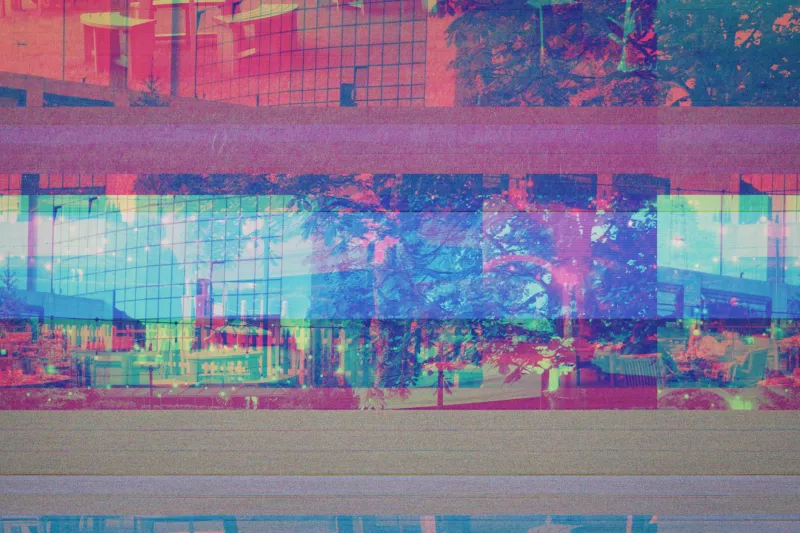
There's a specific kind of image that's been circulating in certain corners of the internet lately. It looks like a dream someone else had — almost familiar, architecturally coherent in the way a fever is coherent, full of text that reads like a language you almost studied once. Colors that don't have names. Faces that are 87% correct. You can't stop looking at it, and you can't exactly explain why.
This is not a glitch. This is the point.
A loose but increasingly influential network of digital artists across the US and beyond has been quietly developing a practice that could generously be called "semantic sabotage." The method: feed machine learning image models — Midjourney, Stable Diffusion, DALL-E and their many forks — with deliberately broken prompts. Corrupted syntax. Words run through four or five translation layers until meaning dissolves into phonetic residue. Phrases scraped from dead websites, encrypted files, malfunctioning OCR scans. The artists aren't asking these systems to understand them. They're asking the systems to hallucinate.
The Prompt Is Not a Command — It's a Crime Scene
Most people interact with AI art generators the way they'd interact with a vending machine: insert specific request, receive specific output. The emerging counter-movement treats the prompt more like evidence of a breakdown — something to be misread, mishandled, deliberately obscured.
Brooklyn-based artist and researcher Mara Koss, who goes by the handle @voidprompt on most platforms, has spent the better part of two years cataloging what she calls "linguistic collapse aesthetics." Her process involves running source text through a sequence of machine translations — English to Swahili to Finnish to Tagalog to Welsh and back — until the semantic skeleton of the original sentence has been replaced by something structurally similar but meaningfully alien. She then feeds that garbled output into image generation systems as a prompt.
"The model has been trained to expect coherent requests," Koss explains over a video call, her screen occasionally cutting out in a way that feels, under the circumstances, extremely on-brand. "When you give it something that has the shape of meaning but not the content, it fills in the gaps from the deepest parts of its training data. That's where things get genuinely weird. That's where it starts making decisions you never could have predicted."
The images that result from her process are striking in a way that's hard to pin down. They feel translated. Not from one visual language to another, but from something pre-visual — like the model is rendering a concept that exists before it becomes an image.
Training Data as Raw Material, Noise as Medium
The theoretical framework here isn't entirely new. Artists have been treating noise as a medium for decades — from the No Wave scene's embrace of degraded recording quality to the glitch art movement's fetishization of corrupted video. What's different now is the scale and specificity of the intervention.
AI image models are, at their core, pattern-recognition engines trained on billions of image-text pairs. When you give them a clean, grammatically correct English prompt, they navigate a well-mapped territory. When you give them something broken, they're operating in terrain they were technically trained on — corrupted text exists in the training data — but not trained for. The model reaches for coherence and grabs something else entirely.
Los Angeles-based collective Signal/Noise Lab has been running a series of experiments they're calling "the void responds" — a name that, yes, feels very at home in these pages. Their approach involves sourcing prompts from corrupted PDFs, OCR-scanned handwriting that was never meant to be machine-readable, and fragments of code stripped of its programming context and fed to visual models as if it were poetry.
"Code as poetry isn't new," says one of the collective's members, who prefers to remain unnamed. "But code as corrupted poetry fed to a system that doesn't know the difference between a function call and a metaphor — that's where you get something that feels genuinely alien. The model is trying to render something it fundamentally cannot parse. The output is its best guess at the shape of confusion."
When Mistranslation Becomes Method
There's a long history of productive mistranslation in the arts — Jorge Luis Borges built an entire literary philosophy around the idea that a translation could be more interesting than the original. But what these artists are doing feels more extreme: they're not translating between languages so much as translating between states of coherence.
Chicago-based visual artist and theorist Devon Parrish frames it in terms of what he calls "the training data unconscious." His argument: every large language model and image generator has absorbed so much human-produced content that it contains, somewhere in its weights and parameters, something structurally analogous to the unconscious — a vast repository of patterns that don't surface during normal operation but become visible when the normal channels are disrupted.
"You're not breaking the model," Parrish says. "You're anesthetizing the part that wants to be helpful and polite. What comes out when that's suppressed is genuinely interesting. It's not random — it's too structured to be random. But it's not intentional either, not in any way we have good language for."
His recent series, Apophenia Engine, consists entirely of images generated from prompts constructed out of corrupted Unicode characters, emoji sequences stripped of their metadata, and phonetic transcriptions of words in languages the model was minimally trained on. The results look like religious iconography from a religion that hasn't been invented yet.
The Aesthetic of Almost-Meaning
What unites all of this work, beyond the technical methodology, is a shared aesthetic sensibility that's hard to describe but immediately recognizable once you've seen it. Call it almost-meaning. The images produced through semantic corruption have a quality of reaching — they look like something that is trying very hard to communicate something it doesn't have the vocabulary for.
That quality resonates with a lot of people right now, for reasons that probably don't need extensive unpacking. We're living through a period of significant communicative breakdown — political, cultural, interpersonal. The feeling of almost-understanding, of meaning that's structurally present but semantically inaccessible, is not an exotic experience for most Americans in 2024. These images look like how it feels.
"That's not an accident," Koss says. "The void isn't empty. It's full of everything that didn't make it through the translation. These images are what that looks like."
Where This Goes Next
The practice is still genuinely underground — you won't find these artists on the trending pages of any major platform, partly because the work is difficult to contextualize and partly because it tends to get flagged by content moderation systems that are, ironically, also AI models struggling to parse what they're looking at.
But there are signs of it bleeding into more visible contexts. Several major digital art platforms have begun featuring work in this vein. A handful of galleries in New York and Los Angeles have shown pieces from artists working in this mode. And the methodology itself is spreading, passed between practitioners in Discord servers and niche subreddits with the energy of something that knows it's onto something.
The machine learned to dream. These artists are teaching it to dream in a language that doesn't quite exist yet. The results are unsettling, beautiful, and — in a way that the cleanest, most technically impressive AI art rarely manages — genuinely surprising.
Which is, when you think about it, exactly what art is supposed to do.