Red String Theory: When Paranoid Visual Culture Went Upscale
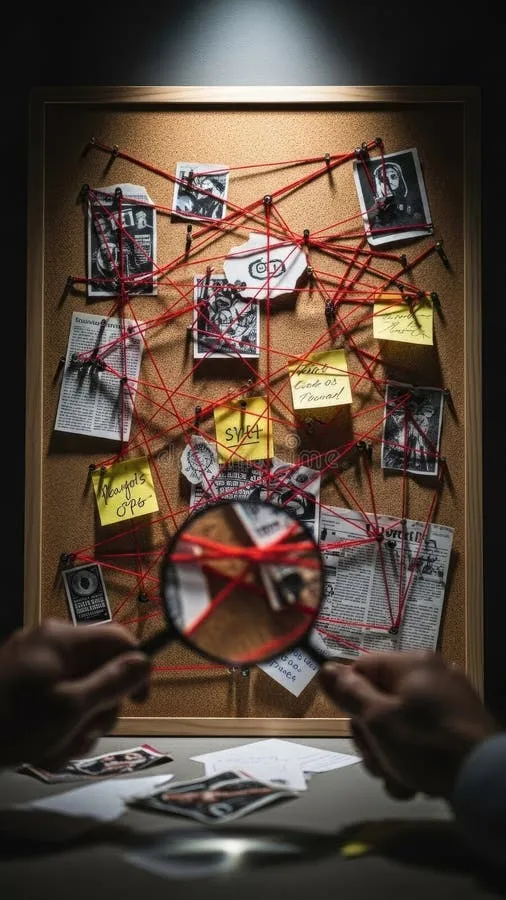
Photo: conspiracy theory corkboard red string aesthetic dark moody, via thumbs.dreamstime.com
There's a specific kind of image you've seen a hundred times without really clocking it. A corkboard covered in overlapping photographs. Strings — usually red, always frantic — connecting faces to locations to cryptic symbols. Handwriting that looks like it was scrawled at 3 a.m. by someone who hasn't slept in days. VHS scan lines ghosting over everything. It used to mean one thing: someone had gone too far down a rabbit hole.
Now it means someone is trying to sell you sneakers.
The visual grammar of conspiracy theory culture — what you could call the paranoid aesthetic — has completed a genuinely strange journey. It started in the margins of internet forums and true crime subreddits, got picked up by indie filmmakers and game designers who liked how unhinged it looked, and has now been fully absorbed into the mainstream design vocabulary of fashion houses, streaming platform marketing departments, and ad agencies billing $500 an hour. The signal got co-opted. The question is whether it still means anything.
The Vocabulary of Distrust
To understand how this happened, it helps to map the actual visual elements involved. Conspiracy aesthetics aren't random — they're a coherent system. There's the degraded media layer: VHS artifacts, film grain, scan lines, the specific kind of blur that old security cameras produced. There's information overload typography: mismatched fonts, redacted text blocks, classified document stamps, numbers that don't quite add up. And there's the corkboard logic: the idea that truth exists in connection, in the frantic webbing between data points that official narratives won't acknowledge.
These elements evolved organically from actual paranoid subcultures — the kind of communities that spent the '90s and early 2000s on early internet forums mapping shadow governments and faking moon landing evidence. But they also drew heavily from pop culture artifacts: The X-Files, Oliver Stone films, Conspiracy Theory with Mel Gibson, the entire aesthetic universe of late-night AM radio. The visual language of distrust has always been partly performance.
What changed was the internet's ability to flatten and redistribute that performance to everyone simultaneously.
From 4chan to Fashion Week
The pipeline is clearer in retrospect than it probably felt while it was happening. By the mid-2010s, meme culture had already been strip-mining conspiracy aesthetics for ironic currency — Pepe the Frog, Illuminati jokes, the "they" in "they don't want you to know this." What started as sincere paranoia became a shared language of ironic detachment, and ironic detachment is basically the native dialect of contemporary youth marketing.
Indie game developers got there early. Titles like Hypnospace Outlaw and Doki Doki Literature Club understood that the visual texture of old, broken, slightly-wrong digital media carried enormous emotional weight. Horror games especially leaned into this — corrupted files, fake operating systems, the uncanny wrongness of technology that doesn't behave. These weren't just aesthetic choices; they were arguments about what authenticity looks like in a world of frictionless digital polish.
Fashion caught on fast, the way fashion always does. By 2020, you could find editorial spreads in major magazines using corkboard compositions, distressed typography, and surveillance-camera color grading. Balenciaga's campaigns have flirted with deliberately ugly, digitally degraded imagery. Streetwear brands leaned into classified-document aesthetics. The visual suggestion of hidden information became a luxury signifier — the idea that this brand, this garment, this product exists outside the official story.
Streaming platforms are perhaps the most revealing case. Title sequences for prestige thrillers and prestige anything-adjacent shows now default to the paranoid toolkit almost reflexively. Flickering text. Grainy archival footage intercut with modern imagery. The suggestion that what you're about to watch is evidence of something.
Authenticity as a Commodity
Here's where it gets philosophically uncomfortable. Conspiracy aesthetics originally derived their power from actual distrust — a genuine, often legitimate suspicion of official narratives, institutional power, and the sanitized surfaces of mainstream culture. The visual language was a symptom of something real.
When that language gets absorbed into the very institutions it was coded to critique, something collapses. A luxury fashion house using redacted-document typography isn't expressing distrust of authority — it is authority, performing distrust as a lifestyle option. The paranoid aesthetic becomes a costume, and a pretty expensive one at that.
Some designers are working with this tension deliberately. Artists like Metahaven, the Dutch design collective, have spent years interrogating exactly this dynamic — how political and dissident visual languages get laundered through commercial design. Their work is genuinely uncomfortable in ways that a Balenciaga campaign is not, precisely because they're asking questions the campaign is trying to foreclose.
In indie gaming and underground net art communities, there's a growing counterreaction — a push toward aesthetics so genuinely obscure, so specifically broken, that they resist easy commodification. If the mainstream wants VHS grain, give them something weirder. If they want red strings, go deeper into the rabbit hole than any marketing department is willing to follow.
What the Signal Costs
The mainstreaming of paranoid aesthetics does something specific to how we read images. It trains us to associate visual distrust — the suggestion of hidden truth, of official deception — with coolness rather than with any actual critical content. We start to feel the vibe of conspiracy without following the logic. The form survives, stripped of its function.
That's not entirely without value. There's an argument that even a diluted version of this visual language keeps certain questions alive — that seeing redacted text on a streetwear hoodie is a tiny, almost subliminal reminder that information gets controlled, that official surfaces lie. Maybe.
But there's an equally strong argument that commodified distrust is actually more dangerous than sincere distrust — because it satisfies the aesthetic hunger for rebellion without requiring any actual critical thinking. You bought the paranoid look. You don't have to do the paranoid work.
The void, in this case, isn't where the signal breaks. It's what happens when the signal gets too clean.