Dead Hardware Walking: Inside the Obsessive Hunt for Obsolete Tech
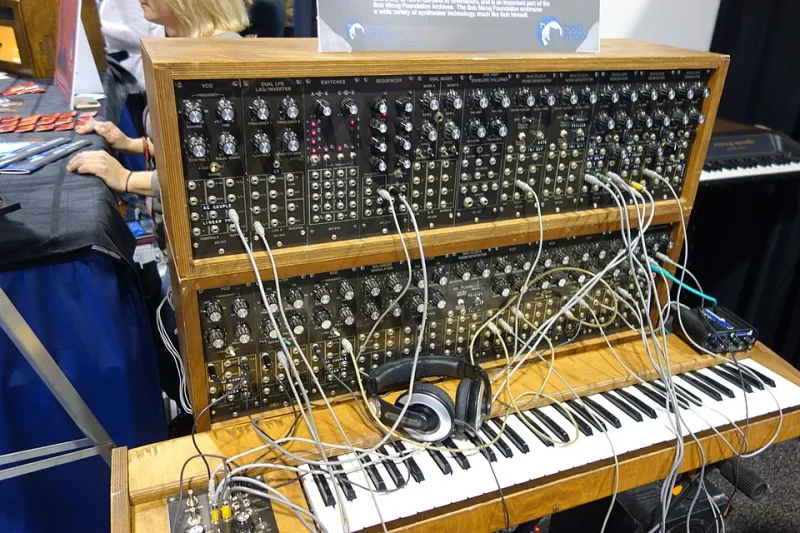
Photo: Pete Brown, CC BY 2.0, via Wikimedia Commons
Jamila keeps a dead Roland Juno-106 on her workbench like a patient in triage. The pitch board is fried, two voice chips have given up entirely, and the previous owner — some guy in Portland who sold it through a Facebook group for $80 — had clearly attempted a repair with what appears to have been a soldering iron and absolute confidence. The synth doesn't work. It hasn't worked for a while. And Jamila, who makes ambient music in a shared studio space in East Nashville, is genuinely thrilled about this.
"The broken parts are the interesting parts," she says, not looking up from the circuit board. "When all six voices work perfectly, it sounds like everyone else's Juno. When two of them are drifting and one cuts in and out, it sounds like mine."
This is the logic of salvage culture — and it's not as niche as you might think.
The Thrift Store as R&D Department
Across the US, a loosely networked subculture of musicians, visual artists, game modders, and hardware tinkerers has quietly built an entire creative economy around technology that the mainstream long ago declared dead. They haunt Goodwill electronics bins, eBay rabbit holes, estate sales in suburbs, and regional swap meets. They're looking for Walkmans with warped tape heads, Game Boys with cracked screens, synthesizers with failing chips, arcade cabinets stripped of their original boards. The more busted, the more interesting.
This isn't nostalgia in any simple sense — though nostalgia is definitely part of the emotional texture. It's something more specific: a philosophical commitment to the idea that degradation is information, that the ways old hardware fails or bends or glitches carry a kind of truth that pristine new technology actively suppresses.
The movement has loose organizational infrastructure but genuine community density. Online spaces like Reddit's r/synthesizers and r/diysound, Discord servers dedicated to specific hardware lines, and YouTube channels with names like "Defective Machines" and "Circuit Bent" have built real knowledge ecosystems around the repair and creative repurposing of obsolete tech. These aren't just hobbyist forums — they're functioning apprenticeship networks, where someone in Albuquerque can learn from someone in Chicago how to stabilize a failing CEM3340 oscillator chip.
Why Old and Broken Beats New and Perfect
The appeal operates on several levels simultaneously, and it's worth unpacking each of them because they're not the same argument.
There's the sonic argument, which is probably the most immediately legible to outsiders. Old analog hardware — synthesizers, drum machines, tape recorders — produces sound through physical processes that introduce variance, warmth, and instability that digital emulation hasn't fully replicated. A Prophet-5 from 1979 doesn't sound like a software plugin of a Prophet-5, and musicians who care about that distinction care about it intensely. When a chip starts to fail, the variance increases — which can mean the instrument becomes more sonically interesting, not less.
Then there's the scarcity argument. In a culture of infinite digital reproduction, where any sound can be cloned and any image can be duplicated without loss, physical objects that can't be perfectly copied carry a different kind of cultural weight. A one-of-a-kind circuit-bent Casio keyboard with a custom noise circuit and a failing oscillator is, by definition, unrepeatable. That scarcity isn't just commercial — it's existential. The thing will eventually stop working for good, and when it does, whatever sounds it made are gone.
And there's the resistance argument, which is maybe the most politically charged. New technology — particularly consumer electronics — is designed around planned obsolescence, proprietary repair restrictions, and seamless integration into corporate platform ecosystems. Choosing to work with hardware that's explicitly outside those systems, that can't be updated or connected or monetized in the usual ways, is a form of refusal. It's not a particularly loud or organized refusal, but it's consistent.
The Repair Underground
None of this works without knowledge infrastructure, and that's where the DIY repair communities become genuinely essential. Learning to work on old hardware is not trivial — it requires understanding electronics at a level that most people abandoned when computers stopped being user-serviceable, plus access to schematics, replacement components, and the accumulated troubleshooting wisdom of people who've already broken and fixed the same machines.
Organizations like iFixit have done important public work on right-to-repair advocacy, but the salvage culture underground operates at a more granular level. There are people who have spent years reverse-engineering the proprietary chips in vintage Roland instruments and producing compatible replacements. There are communities dedicated to keeping specific arcade hardware alive — JAMMA boards, CPS2 systems, Neo Geo cartridges — not for commercial reasons but because they genuinely believe the hardware is worth preserving. There are circuit bending workshops happening in DIY spaces from Brooklyn to Oakland, teaching people how to deliberately destabilize electronic circuits to create new sonic possibilities.
The knowledge transfer is often explicitly anti-commercial. People share schematics freely, post repair guides without paywalls, and document their processes in public forums specifically because they understand that the culture only survives if the knowledge is accessible.
When Junk Becomes Canon
What's striking about salvage culture's current moment is how much cultural legitimacy it's accumulated without really trying to. Artists working with obsolete hardware are showing at respected galleries. Musicians using circuit-bent instruments and degraded tape machines are releasing records on labels that get serious critical coverage. The aesthetic of deteriorating technology — the visual texture of old monitors, the sonic character of failing tape — has become so widely recognized as interesting that it's started to influence mainstream production, which creates its own irony.
There's a version of this story where salvage culture gets absorbed the same way conspiracy aesthetics did — where the look of broken hardware gets packaged and sold back to people who don't want to actually fix anything. Vintage-style filters. Lo-fi playlists. "Analog warmth" plugins. The simulation of degradation without the degradation itself.
But the hardcore salvage community seems fairly resistant to this, partly because the actual practice is a genuine barrier to entry. You can't fake your way through a Juno-106 repair. You either learn the circuit or you don't.
Jamila eventually gets two of the dead voice chips talking again. The pitch board is still a problem. The synth sounds, she says, "like it's remembering something it can't quite get to." She's going to record with it this weekend, exactly as it is.
The void doesn't need to be fixed. Sometimes it just needs to be heard.