Dial It Down: How Throttled Connections Became the Hottest Creative Tool Nobody Expected
There's a particular kind of image that's been circulating in certain corners of the internet lately — blurry, pixelated, almost impressionistic. Not because the camera was bad, but because the connection was. Deliberately. Intentionally. By choice.
Welcome to the bandwidth mystique, where slower is smarter and digital scarcity is the new luxury.
The Rebellion Against Infinite Resolution
We live in a moment of almost absurd digital abundance. Fiber-optic speeds, lossless audio, 8K video streams — the infrastructure of modern creativity keeps pushing toward a kind of frictionless perfection. And yet, a quiet counter-movement is building in studios, basements, and co-working spaces from Brooklyn to Portland, one where artists are actively throttling their connections, capping their speeds, and working inside the constraints that most of us would consider a technical nightmare.
The logic isn't as counterintuitive as it sounds. Constraints have always been creative rocket fuel. Punk's three-chord ethos. Lo-fi hip-hop's tape hiss. The Dogme 95 filmmakers who banned artificial lighting and post-production effects. Every generation finds a new wall to work against, and right now, the wall is bandwidth.
"When you remove the option to just throw more data at a problem, you start making decisions that actually mean something," says one Brooklyn-based visual artist who asked to be identified only as Mira. She works with a self-imposed cap of 1 Mbps during her studio sessions — roughly the speed of an early 2000s DSL connection. The results are canvases of compressed artifacts, half-loaded images, and color-banding that looks like something between a Rothko and a corrupted JPEG. Which, honestly, is exactly the point.
The Sound of a Bad Connection
The audio world got here first. Lo-fi producers have been fetishizing degraded sound quality for years, but a newer generation of musicians is going even further back — sampling the actual tonal textures of slow internet. Dial-up modems. Buffering tones. The specific warble of a video call dropping mid-sentence.
Artists like Chicago's Ferris Null (a producer name, not a legal one) have built entire EPs around sounds sourced from bandwidth failure. His 2024 project Latency opens with a four-minute track built almost entirely from the sonic artifacts of a video stream struggling to load — the digital stutter, the audio dropout, the weird pitch-shifting that happens when packets arrive out of order. It's unsettling and oddly beautiful, the kind of thing that sounds like the internet is dreaming.
"People hear a buffering wheel and feel anxiety," Ferris told an interviewer last year. "I wanted to flip that. Make it meditative. Make it the texture, not the obstacle."
He's not alone. Across SoundCloud and Bandcamp, a loose genre tag — sometimes called "lag music" or "packet loss" — is accumulating releases that treat the sonic fingerprints of poor connectivity as instruments in their own right.
Pixelation as Paintbrush
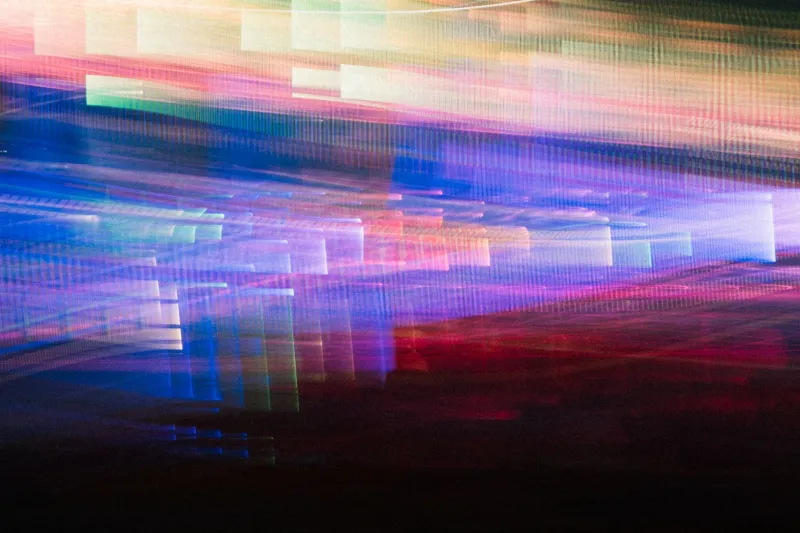
On the visual side, the aesthetic is equally distinct. There's a specific look that emerges when high-resolution images get forced through narrow pipes — colors posterize, edges dissolve into blocky artifacts, gradients collapse into hard steps. For a certain kind of visual artist, that's not a bug. It's a vocabulary.
Photographers and digital illustrators are increasingly building workflows designed to introduce this kind of compression damage at specific stages. Some run finished images through deliberately slow FTP transfers. Others use vintage modems as actual hardware filters, piping image data through connections that physically cannot handle it cleanly. The output looks like something between early web art and a fever dream — simultaneously nostalgic and completely alien.
The connection to the broader glitch art movement is obvious, but bandwidth-constrained work has a different flavor. Where glitch art often feels aggressive, deliberately broken, the slow-internet aesthetic carries something more melancholy. It's not a crash. It's a struggle. The image is trying to arrive and almost making it.
Developers Building for the Edge
It's not just artists. In the developer community, there's a growing interest in what's sometimes called "edge-first" or "low-bandwidth-first" design — building digital experiences that don't just tolerate slow connections but are genuinely shaped by them.
Some indie game developers are releasing titles specifically designed for 56k-equivalent speeds, where the load time itself becomes part of the experience. One text-based game released earlier this year throttled its own text delivery to simulate the cadence of a dial-up connection, forcing players to read at the speed the network would have allowed in 1998. Reviewers called it either insufferable or transcendent, depending on who you asked.
Web designers in the same orbit are building sites with strict data budgets — 100KB total, no exceptions — that end up looking more like concrete poetry than conventional web pages. The constraint forces a kind of radical editorial discipline. Every element has to earn its place.
Why Now?
It's worth asking why this is happening at this particular cultural moment. Part of it is straightforward nostalgia — millennials and older Gen Z creators grew up with slow internet and are now aestheticizing the texture of their childhood digital lives. But there's something more pointed going on too.
In an attention economy that rewards speed, volume, and algorithmic optimization, choosing to work slowly — to build things that don't load instantly, that require patience, that resist the frictionless scroll — is a genuinely political act. It's a rejection of the idea that more bandwidth equals more value, that faster is always better, that the goal of all creative work is maximum reach at maximum resolution.
There's also something honest about it. In a country where broadband access is still deeply unequal — where rural communities and low-income urban neighborhoods are still living on connections that the tech industry treats as embarrassing relics — making art from that constraint is a way of acknowledging that reality rather than papering over it.
The Signal in the Slowness
Voidcast has always been interested in what happens where the signal breaks. And there's something almost poetic about the fact that the creative frontier right now isn't being pushed by more bandwidth, more resolution, more processing power — it's being carved out in the gaps, the lag, the pixelated half-arrivals.
Slow internet, it turns out, has a lot to say. You just have to wait for it to load.