Art That Knows It's Dying: Meet the Glitch Prophets Engineering Their Own Obsolescence
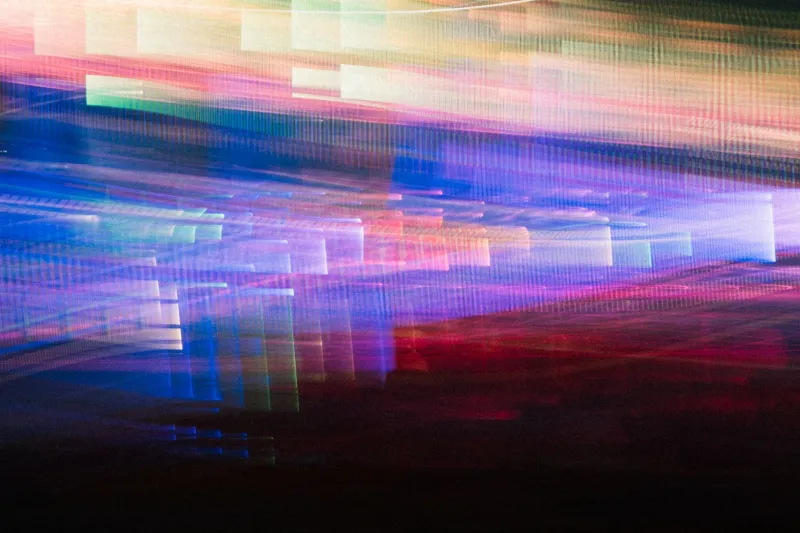
There's a piece currently circulating in certain very online corners of the digital art world — a looping video that looks perfectly fine the first time you watch it. Clean lines, deliberate color, the kind of thing you'd expect to see projected in a Chelsea gallery at $4,000 a print. But embedded in the metadata, invisible to the naked eye, is a countdown. The file is slowly, methodically eating itself. And the artist behind it already knows exactly what it'll look like when it does.
This is predictive glitch art, and it's weirder and more philosophically loaded than it sounds.
The Setup: When the Machine Learns to Rot
The core idea is deceptively simple. A handful of artists — scattered across Brooklyn, Portland, Austin, and a few cities you'd never expect — are using machine learning tools to model the degradation of their own work before it happens. They feed training data made up of corrupted files, deteriorated video formats, and decades of digital decay into models that spit out what a given piece will look like in five years, ten years, after a hundred bad file transfers.
Then they build that future failure directly into the present version of the work.
"Most art is made to resist time," says one artist who goes by the handle Null/Meridian and operates out of a shared studio space in East Nashville. "We varnish paintings, we archive files, we restore. I'm doing the opposite. I'm making work that's already grieving itself."
Null/Meridian's recent series, Eventual, consists of twelve digital prints that exist in two simultaneous states: the version you see now and a predicted version generated by a custom-trained model, displayed side by side. The degraded futures aren't guesses — they're calculated probabilities, rendered with an eerie specificity that makes them feel less like predictions and more like memories.
Determinism as Aesthetic Choice
What makes this scene philosophically interesting — and genuinely strange — is the way it collapses the distance between creation and destruction. These artists aren't just accepting that their work will decay. They're arguing that the decay is the work. That the future failure state is as authored, as intentional, as the version you encounter on day one.
It's a position that bumps up against some deep questions about what art even is. If you design the breakdown, do you own it? If the glitch is predicted, is it still a glitch? Or does knowing the shape of a thing's death change the meaning of its life?
Artist and theorist Drea Solano, who teaches digital media at CalArts and has been tracking this movement closely, frames it in terms of technological determinism. "There's a strand of thought that says our tools shape us more than we shape them — that the machine's logic inevitably wins," she says. "What these artists are doing is accepting that premise and then asking: okay, but what if we ran the tape forward? What if we looked at the predetermined outcome and made that the point of departure?"
It's a move that would feel fatalistic if it weren't executed with such obvious enthusiasm. The artists working in this space aren't mournful about obsolescence. They're obsessed with it the way a good mechanic is obsessed with knowing exactly how an engine will fail — not defeated by the knowledge, energized by it.
The Tools Are Getting Weird
Part of what's enabling this scene is the increasing accessibility of machine learning pipelines that don't require a PhD to operate. Tools originally built for video upscaling, file restoration, and format conversion are being run in reverse — fed corrupted inputs to learn the language of deterioration rather than the language of clarity.
A collective operating out of Philadelphia called Sector Drift has been particularly inventive on this front. Their open-source toolkit, which they've been quietly distributing through Discord and a few niche GitHub repositories, lets users train small models on their own corrupted archives. The output is a kind of personalized decay engine — a system that learns your specific aesthetic history and predicts how your specific files will fall apart.
"Everyone's digital life degrades differently," says a Sector Drift member who asked to be identified only as Wren. "Your compression artifacts aren't my compression artifacts. We wanted a tool that understood that — that could give you a portrait of your own eventual failure that was actually yours."
The results people are generating with this toolkit have a haunting specificity. They look less like generic glitch art — the rainbow smears and blocky artifacts that became a visual cliché somewhere around 2015 — and more like documents. Evidence of something.
The Market Is Watching, Awkwardly
Predictably, the art market has started sniffing around the edges of this scene, and the artists involved have complicated feelings about it. The whole philosophical premise depends on the work being temporary, self-consuming, oriented toward its own end. Selling a piece for $15,000 to a collector who wants to preserve it creates a certain tension.
Some artists have leaned into that tension as part of the concept — selling works with contractual stipulations that the collector cannot attempt to restore or preserve the file, must allow it to degrade naturally, and in some cases must delete it entirely when it reaches a predicted threshold of corruption. Others have sidestepped the market entirely, distributing work through torrents or time-limited links that expire on a schedule the artist controls.
Null/Meridian sold three pieces from the Eventual series last year and donated the proceeds to a digital preservation nonprofit — which they describe, with a straight face, as "the most appropriate thing I could think of."
Why It Matters Right Now
There's something going on here that feels specific to this moment. We're living through a period of accelerating technological obsolescence, where the software you learned six months ago is already being deprecated, where the platforms that defined a generation of online culture are visibly rotting in real time. The anxiety about what we're losing — and how fast — is everywhere.
Predictive glitch art doesn't resolve that anxiety. But it does something maybe more useful: it looks at it directly. It says, yes, this is ending, here's what the ending looks like, and here's what we made in the meantime knowing that.
That's not nihilism. That's something closer to honesty.
The signal always breaks eventually. These artists just decided to be there when it happens — and to have already drawn the map.